
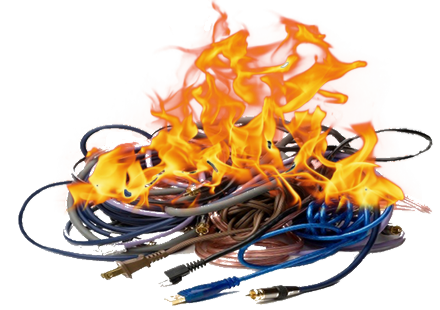
 In the late 1970s a number of rather questionable companies entered the home audio market with claims of miraculous results achieved by swapping patch cords. Using their extremely expensive patch cords, of course.
Their presentations were truly convincing as they gave their talk about things like skin effect, metals, standing waves, cryogenics and Litz wires. Of course, when they hooked these miracle cables up everyone, pumped by the presentations, heard the difference immediately. "It's so open and the soundstage is fantastic."
Since then there has been a running argument in the audiophile world about whether the effects are real or the result of wishful thinking and psychology used in the demonstrations.
Many educated people, even engineers, have tried to calm this down by debunking the claim these extortion priced cables are better. They've done comparisons, they've done all kinds of tests and so far nobody has chilled the debate. But, most importantly, none of these companies have proven their cables actually are better. The debate hangs in limbo, physics vs faith, continuing to this day.
Thinking about this, it occurs to me that both sides are asking the wrong question. They want to know if the expensive cables are better but the real question is: Are the cheap cables good enough?
Lets explore what is demanded of an RCA patch cord, then create a worst case scenario and see if I can make a cheap cable mess up.
Unbalanced signals
Unlike balanced cables, unbalanced or "single ended" cables take the output of one device and couple it directly into the next device in the chain. This means they have no means of noise reduction or error correction.
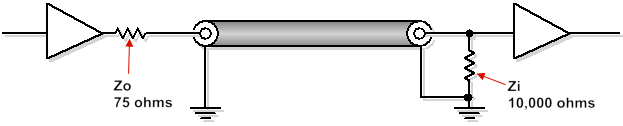
In the image the resistor marked Zo is the output impedance of the preceding stage and Zi is the input impedance of the next stage. Following the general rule of Impedance Bridging, Zo will be about 75 ohms and Zi will be greater than 10,000 ohms.
Also note that in this type of signalling the grounded shield is more than a simple reference. It actually handles the return current resulting from the signals and provides at least some protection from local interference.
RCA cable power handling
Based on the standard consumer Line Level we can calculate the current and power that is passing in our patch cord as well as the damping factor inherent in the connection.
- Voltage:
- Line level == 0.477 volts peak
- Current:
-
I = V / (Zo + Zi) = 0.447 / (10,000 + 75) == 0.0000443 amps
converting x 1,000,000 = 44.3 microamps - Power:
-
P = V x I = 0.447 x .0000443 == 0.0000198 watts
converting x 1,000,000 = 19.8 microwatts - Damping:
- DF = Zi / Zo = 10,000 / 75 == 133.33
Yes, RCA patch cords really do run on these miniscule power levels. The signal transfer from device to device is almost purely by voltage.
Test setup
To complete my experiment, I needed the cheapest patch cord I could find. I ended up with a stereo patch cord, 6 feet long, for $11.00 from a local electronic parts dealer. This is one icky cord, the kind of thing any self-respecting audiophile would throw in the garbage.
But will it fail my test?
I decided that I wanted to hook up as close to the connectors as I could. I didn't want anything hidden behind a baffle or inside a box. I also didn't want to be testing my clip leads. So I tack soldered some short wires onto the end I was going to use as the input and added a dummy load resistor on the output end.
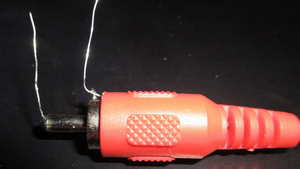
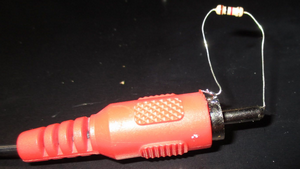
I then connected my Signal Generator, which has an output impedance of 75 ohms, to the input end. Channel 1 of my Oscilloscope was connected to the input as well. Channel 2 was connected to the output with the resistor attached. This allows me to simultaneously monitor both ends of the cable.
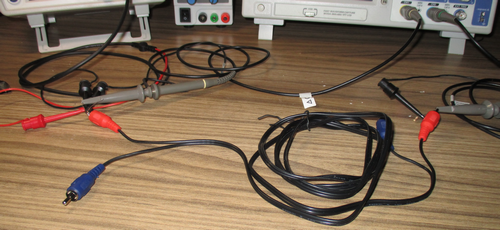
In order to encourage failure, I terminated the output end with a 1,000 ohm resistor, 1/10th of what you would normally expect at an amplifier's input. This will result in 10 times more current (443 microamps) and 10 times more power (198 microwatts) than we would expect in normal use. Then I upped the voltage to 1 volt peak (2 volts peak to peak). This will again double those figures; 886 microamps and 396 microwatts in all. If a cheap cord is going to fail, operating it at 20 times its normal stress should do it.
Almost ready to feed it some signals and see how it does.
Null testing
In order to affect sound quality, a cable has to change the waveform passing though it in some way. This is easily tested using an oscilloscope set up to do a "Null Test"
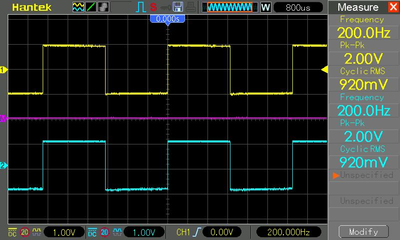
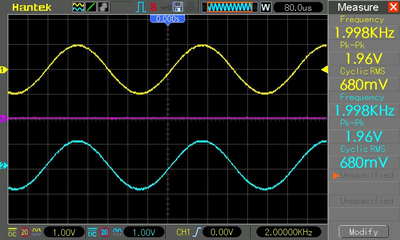
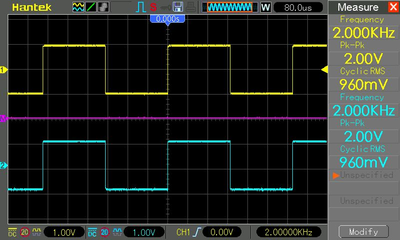
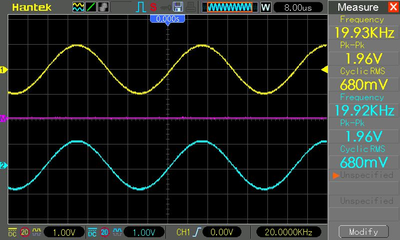
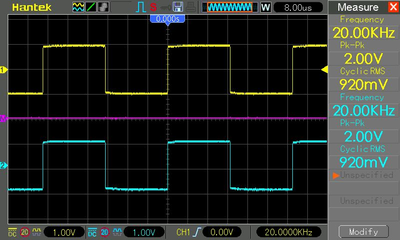
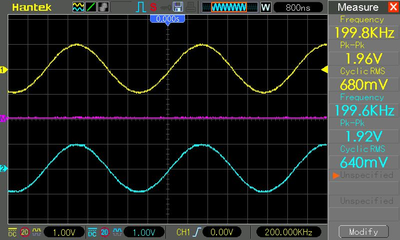
For my tests, the top trace is showing the input to the cable, the bottom one is showing the output. The output is subtracted from the input and any difference between them is shown on the middle trace.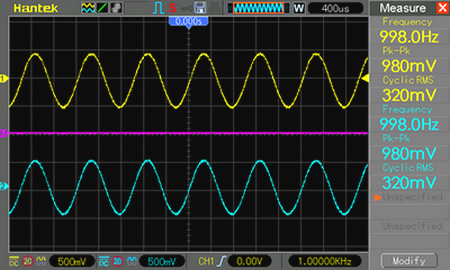
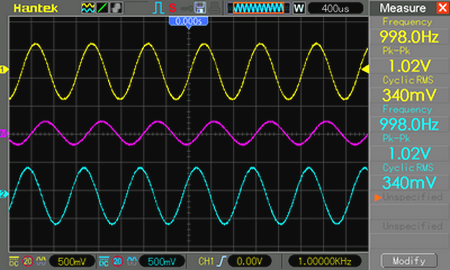
It is important to understand the centre trace will show any difference, no matter what it is. As you can see above, even a small change in phase results in a strong output. Changes in amplitude, phase, frequency, waveshape, noise, interference and more will display on that centre line. So, the less active that centre null trace is the better.
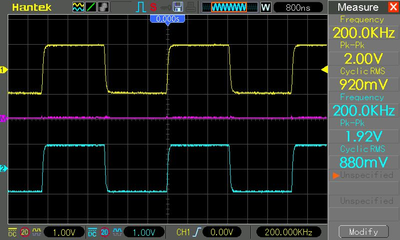
There is considerably more information we can also get from a test setup like this. While it will detect differences, it will also show noise and interference, changes in waveforms and, using square waves, it will show us good information about frequency response. Poor high frequency response will result in the leading edges of the square waves being rounded off. Poor low frequency response will result in the tops of the waves being slanted downwards.
If the signal is changed in any way, we're going to see it.
Ironically, any of these "high end" cable makers with their wild claims could easily use null testing to show the effect their cable has on sound quality. But, so far, none of them has risen to the challenge.
Test results
In standard audio tests, the definition of success is that the cable passes the input signal accurately over at least the 20-20khz audio range.
I tested at the decade points, starting at 2hz going up in multiples of 10. At each stop I ran both a sine and a square wave test, with these results:
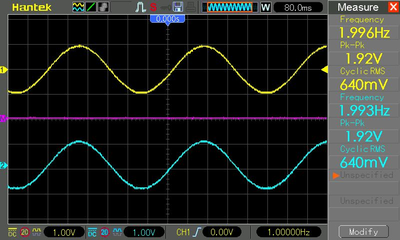
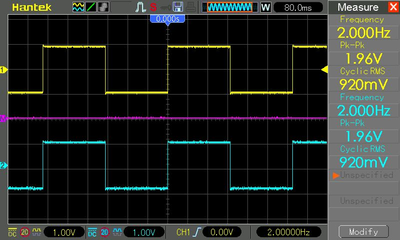
20hz: Lowest required frequency
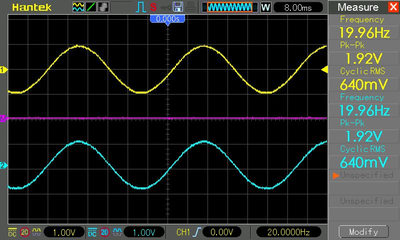
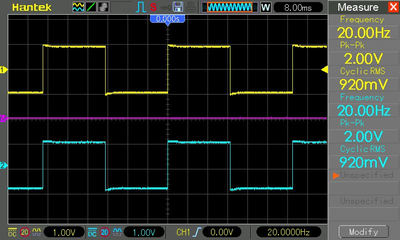
200hz:
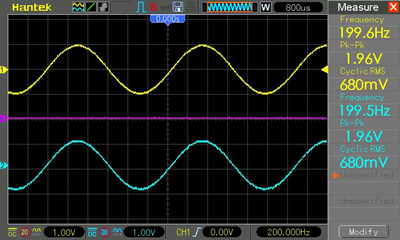
2,000hz:
20,000hz: Highest required frequency
200,000hz: Small drop in output, frequency response issues beginning to show
2,000,000hz: Loading the input and poor frequency response
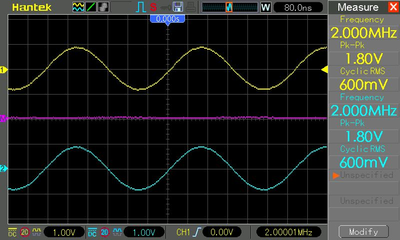
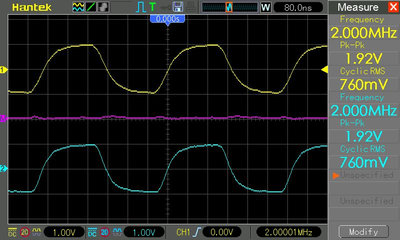
Even at 20 times normal stress, the first sign of trouble was at 200khz, 10 times the requirement. I got all the way up to 2Mhz, 100 times the requirement before my ultra-cheap cable started clearly faltering.
Not only did this cheap cable not fail, it far exceeded the test requirement.
Similar tests have been conducted by Audio Science Review and others, using test equipment far more sensitive than my own, with similar results. Always the conclusion is that even the cheapest RCA cables are more than adequate for general home audio use.
Summing up
In the same way a car does not get easier to tow when we use a bigger rope, once we have a cable that can carry our signals, the exotic and always more expensive ones bring no added benefit whatsoever.
Except at the edge of failure an RCA cable will not add or subtract anything and it certainly can't edit the waveforms passing through it. Wire is not magic. It is the most passive of all the passive components in electronics. It is beautiful in its simplicity: put a signal in one end and it comes out the other. Job done.
Save your money. The cables supplied in the box with your equipment are usually more than good enough.
If you want to examine the full size scope shots you can Download them in a zip file.