
 A fast growing trend in home audio is to borrow technology from pro-audio. We are seeing internally amplified speakers and studio monitor speakers being introduced to home systems. Pro-quality amplifiers are being used more and more in home audio. To connect this all up, we are seeing pro-audio's balanced interconnects being offered on more and more consumer level equipment. But the value of this is questionable.
In noisy environments Balanced Audio, as it's called, offers real advantages over the "old way", using shielded cables and RCA connectors. You get less noise, almost no interference and much quieter backgrounds. It's all good.
But, in home audio where interconnects are short and noise is often way below the threshold of audibility, Balanced Audio offers little or no advantage. It can't be used to cancel noise that isn't there.
Typical of consumer electronics and the competitive rush to market, the implementation of these borrowed technologies is highly variable. While some equipment does an excellent job with it, an equal amount ranges from poor to self-defeating in quality.
So, lets look at this and see what does and does not work.
It started with phone lines
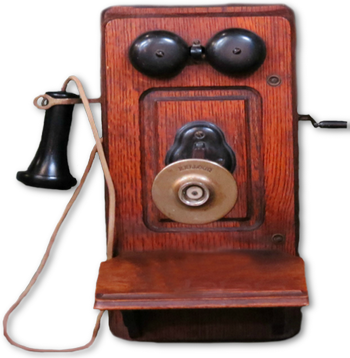 The original phone systems developed by Bell Labs were pretty simple devices. To talk to someone else they simply connected your handset in series with the other handset and a battery, using patch cords at the exchange. This created what was called a "current loop". They used simple carbon microphones that would modulate the current as you spoke and the ear pieces at both ends would vibrate with the modulated current.
But as these new fangled telephones became more popular, problems began to surface. As they started bundling more and more lines together on poles, people started hearing other conversations at low levels and there would be crackling noises from radio signals, lightning and other sources of electro-magnetic interference. This limited both the distance and the quality of the connections.
It wasn't long before someone (Arguably Bell, himself) figured out the problem was that random noise was being picked up by the lines. The longer the lines the worse the problem got. As we see below, the two handsets were being affected by the noise, making it audible on both ends.

They eventually figured out that by twisting the two wires of each phone line together, the noise and side-talk stopped. This was because the wires were in very close proximity and were affected equally by the noise and interference. When the noise affects both sides of the handset equally, there is no difference in voltage across the handset, causing no change in current. The noise while still present, became inaudible, but the voice signal still carried through.

This simple trick allowed the phone companies to bundle hundreds, even thousands, of individual lines into cables that ran all over North America and gave us crystal clear voice communications for many years.
Early pro-audio
As sound reinforcement and recording became more popular sound engineers initially used simple shielded wire and almost immediately ran into the same problem as the phone companies. Cross coupling between wires and interference from power cords and electrical equipment began to creep into their sound systems.
The solution they worked out wasn't all that different than the one used by the phone companies and took advantage of the way dynamic microphones develop their outputs across a voice coil and how transformers react to signals at their inputs.
A transformer is an isolation device that has no direct connection between it's two windings. When a voltage is developed across the primary side, current flows and the signal is inductively transferred to the secondary winding. But, like the telephone handset when a Common Mode signal affects both sides of the transformer's primary winding equally, no change in current occurs and no signal is induced into the transformer's secondary winding.
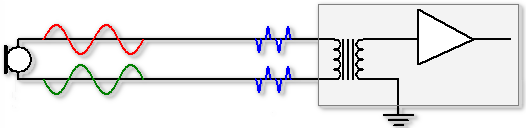
In the example above the microphone, on the left, is outputting two opposing voltages (shown in red and green) from it's internal coil into a twisted pair of wires. These signals then drive the transformer which in turn drives the amplifier. But, noise (shown in blue) affects both ends of the transformer equally and thus does not cause a signal in the transformer's secondary, keeping it out of the amplifier.
Modern systems
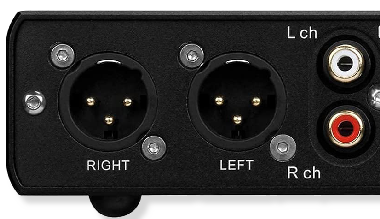 Since the early days of balanced audio, things have moved along considerably. Balanced connections are not just for telephones and microphones anymore, they are now widely used between all sorts of equipment. Following their long term successes in the pro-audio world they are finding their way into home audio systems.
Properly balanced inputs and outputs promise to solve a lot of the problems inherent in RCA cables. They will prevent hum and noise pickup on longer runs. They will reduce interference from all sorts of other devices, especially from cell phones, routers, strong radio stations and, yes, even the CBer across the street. "Breaker Breaker any taker!"
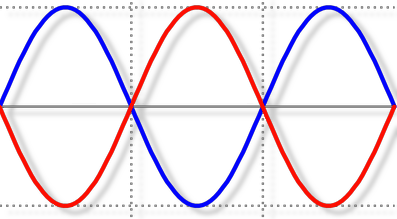
The operating principle is the same as it was for the old phone lines. It uses two opposite phased signals, dubbed "Hot" and "Cold". Any signal in opposing phase will cause an output from the receiver. But, any signal in phase on both wires is considered to be noise and will be ignored.
The overall topology inside a balanced device is pretty simple. It still uses the well known and trusted single ended circuitry, but adds the receiver and sender pair for balanced inputs and outputs. So, first, reintegrate the out of phase input signals into a single ended signal, then process the signal as usual and, finally run it through a phase splitter to produce a balanced output signal for the next device.

At the receiving end an integrator circuit (usually an operational amplifier) is used to recombine the two signals into a single ended signal that is processed by the device's electronics. With the appropriate gain settings, this could be the low level signals of a microphone or instrument pickup or, in studio or home audio environments, it can be the Line Level output from a previous device.
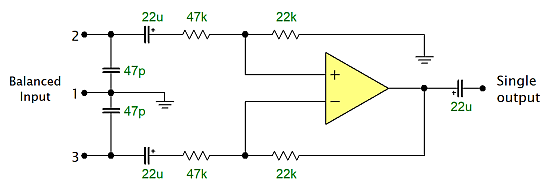
The schematic section below shows a typical balanced receiver. It uses an op-amp in differential mode. Any signal coming in on pins 2 and 3 of the input is run through the op-amp. For music or voice signals pins 2 and 3 will be out of phase and drive the inputs differentially to produce an output from the op-amp. However, noise is going to be in phase (common mode) and will affect both inputs the same way producing no output. The signal makes it through but the noise does not.
After processing the signal, the device (DAC, Amplifier, Pre-amp, etc.) needs to reconstruct the balanced signals before sending them off to the next device in the chain.
The balanced sender is most often a phase splitter that takes a single ended signal, runs it through a simple buffer and an inverter, as shown below. This creates the two opposing outputs that drive the cable. The output that is in phase with the input is generally called the "Hot" output (pin 2). The inverted signal is most often called the "Cold" output (pin 3).
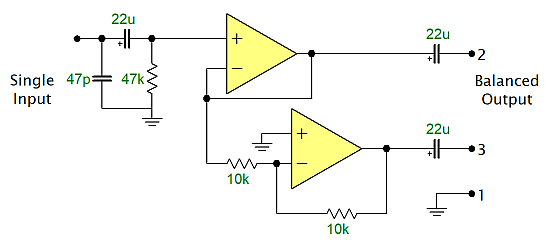
This arrangement has the advantage that any noise or interference not only does not get past the balanced receiver and into your device, it is also not passed along to the next device to cause problems there. In a multi-link chain of devices, noise is confined to cables and will not get past the first link it appears on.
Be sure to understand the magic here is not in the cables. Balanced cables are no more immune to interference than standard cables. What is different is the way your equipment deals with the noise and interference. It is the sender/receiver pair inside your devices that does the heavy lifting and keeps your signals clean.
Balanced cables
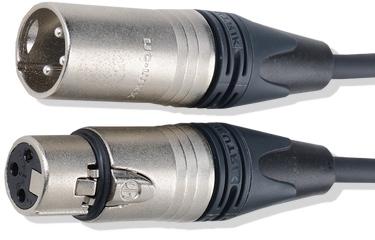 Far and away the most common Balanced Cable, is the XLR cable. But that is not the only option. You can also do balanced wiring with the stereo TRS phone plugs we are already familiar with on headphones. Of course your cable choices will depend on the connectors used on your equipment. Perusing any online distributor will find you a wide range to choose from, at all price points.
It should be noted that, by convention, the back panel of a balanced audio device will use XLR male connectors for it's outputs and XLR females for it's inputs. This, of course means that every XLR cable needs a male connector at one end and a female at the other. The advantage to this arrangement is that you can't accidentally plug an output into an output and damage your equipment. In multi-cable setups, you can also easily identify which cables are inputs and which are outputs by looking at the connectors.
Dual mode inputs
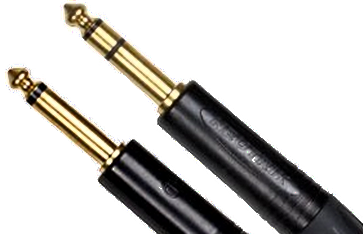 Another trend is toward dual mode inputs that can act as both balanced and unbalanced connections. This is generally done with TRS phone plugs instead of XLR connectors.
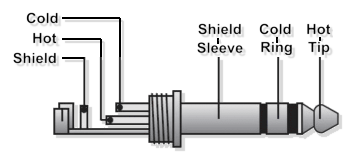
The TRS phone plug is a three conductor plug. The sleeve is for the shield, the cold connection is on the ring and the hot connection is on the tip. Thus it can carry a balanced signal correctly.
But, TRS input jacks also know a nice trick. If you insert an unbalanced (mono) TS plug, which has a longer sleeve, the Cold input is grounded by the sleeve and it will work as an unbalanced connection. This lets you use traditional unbalanced (RCA) outputs on balanced inputs with only a slight drop in signal levels.
This, of course, has the down side that you've got to be very careful what you're plugging in where. Plugging a TS cable into a TRS output could damage your equipment.
DIY cables
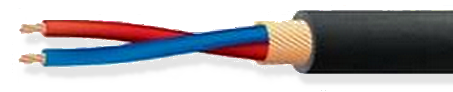 For those with a Do It Yourself bent, making your own balanced cables is not difficult, but you will need to know how to solder.
Balanced cables use a 2 wire cable with a surrounding shield. There is almost no current flowing on these cables so you can use smaller gauge wire. 24ga wire is more than good enough for home audio use and gives you a small diameter, flexible cable. Each wire needs to be separately insulated and they must be twisted together inside the shield. The shield braid needs to be about 70% coverage. If you can get wire with a foil shield that's all the better.
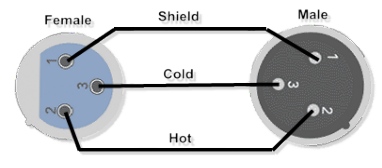
For standard XLR to XLR cables connect the shield to pin 1. The Hot signal goes to pin 2 and the Cold signal goes to pin 3. I'm not aware of any colour coding rules and not all cables have the same colour wires, so I usually use the brightest coloured wire for my Hot connection, on pin 2.
For TRS to TRS cables you would hook the Shield on the plug's Sleeve. The Cold signal goes to the Ring and the Hot signal goes to the Tip, on both ends of the cable. Please note that the solder point arrangement on these plugs varies from manufacturer to manufacturer, so you should spend a moment to confirm which solder tab connects to each contact on the plug.
Other combinations such as TRS to XLR should be fairly easy to figure out. Just make the connections at each end as appropriate.
Cable trickery
You might find yourself in the situation of having to hook an old style unbalanced connection up to a balanced system. This is not advisable as a permanent setup but it can be done.
To hook an unbalanced output to a balanced input you would use 2 wire + shield cable and connect the balanced end as usual but you need to cheat a bit at the unbalanced end. Since this will almost always be an RCA connector, connect the Hot lead to the RCA centre pin. Connect the shield to the RCA ring. Then add a 75 ohm 1/8 watt resistor in series with the Cold lead and also connect it to the RCA ring. This arrangement drives only the Hot lead and will result in a level drop of about 6db but it will at least give you some noise cancellation.

To hook a balanced output to an unbalanced input you would use a similar scheme to the above but you don't need the resistor. Just leave the Cold wire unconnected.
If you need a more permanent solution when connecting balanced and unbalanced equipment, you should look into proper adaptors that will adjust the levels, give you truly balanced signals and all the benefits of noise cancellation. Cable tricks are not the way to go in a long term setup.There are issues
All this technical wizardry is not without it's problems and some of them can be rather expensive. Some manufacturers are using the trend to drive up prices, others are cheating and not providing truly balanced signals. In any case, it's the end user who pays.
Fully balanced audio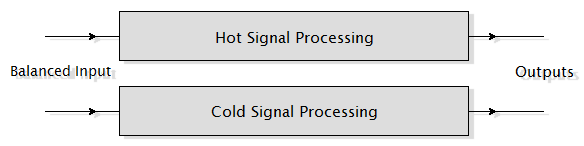 Alongside the progress in balanced audio and it's greatly reduced noise and hum, a trend of "Fully Balanced Audio" has appeared. This is largely in the more "high end" consumer equipment and as a rule it carries a much higher price tag to go with it.
The idea is simple, but rather misguided: "If balancing cables is a good idea why not balance the entire device?"
-
There's so much wrong here it's difficult to know where to begin:
- By taking the hot and cold signals directly into the device's internal signal path it will not know the noise isn't part of the signal and any noise or interference on the cable will propagate through the device where it is likely to be amplified and then handed off to the next device in the chain, where it could then be seen as part of the signal.
- It uses twice as much electronics, requiring four active signal paths for a stereo device. This will tend to make it use more power, produce more heat and be twice as prone to failure.
- Even the slightest mismatches between the signal processing circuits can result in phase shifts and amplitude mismatches that will tend to unbalance the outputs propagating those errors to the next device in the chain.
- It is prohibitively expensive for no real gain in function.
Suffice it to say this is a bad idea from the beginning but some companies are doing it anyway.
The dead pin trick
Another thing to watch out for is the "Dead Pin" trick. Some companies are putting XLR connectors on equipment but not including the balanced audio receiver and sender. Instead they are simply either grounding or ignoring the "Cold" signal and running their gear -and yours- single ended. This works, in that it treats the balanced cable like an RCA cable and it will produce an output, but you get none of the benefits of balanced audio from it.
Fortunately this trick is easy to catch. Check pin 3 (Cold) of the XLR connectors: Is there a signal there? Is the pin grounded?
Summing up
Balanced audio is now part of the home audio marketplace. We will soon be seeing more and more equipment with balanced interconnects and, yes this is a good thing, well justified on the reduction in hum, hiss and interference.
Unfortunately, the snake oil has already started as companies that either prey upon their customers or simply don't understand are already getting into the game. The worst offenders are the "high end" companies offering "Fully Balanced" equipment and the low-ballers playing the "Dead Pin" trick, to get more of your money. Soon enough it will be too easy to overspend insanely on cables and gadgets for your balanced audio setup.
As always; Caveat Emptor, Buyer Beware. Stay with average priced products and you will do fine.