
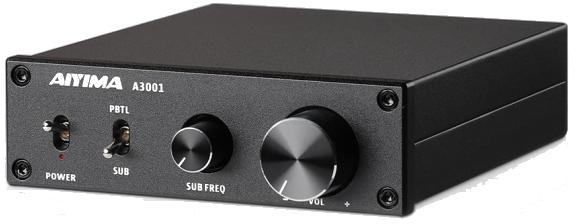
 The
Aiyima A3001
power amplifier is an older design monophonic power amplifier, featuring dual mode operation. In Sub mode it will drive passive subwoofers. It is also a full range mono-block type amplifier when in PBTL/Flat mode.
The
Aiyima A3001
power amplifier is an older design monophonic power amplifier, featuring dual mode operation. In Sub mode it will drive passive subwoofers. It is also a full range mono-block type amplifier when in PBTL/Flat mode.
This amplifier is based on the very robust TPA3255 class D amplifier chip, wired into PBTL (Parallel Bridge Tied Load) mode. Using the supplied 36 volt 6 amp power brick, this wee beasty will easily deliver 150 watts RMS on a 4 ohm load, 110 watts on 6 ohms and 75 watts on 8 ohms, with very low distortion and with virtually no background hiss or noise.
The rear panel Sub-Out jack is level controlled by the volume control. It is active and filtered all the time allowing you to also manage an active subwoofer in the full range mode.
The volume and frequency controls are detented and have enough resistance to movement to help you keep your settings stable.
The two RCA inputs on the back are immediately summed to mono. So you can feed it a stereo signal if you wish. However, for use as stereo monoblocks you should connect only one channel from your source to each amplifier.
All very nice...

The internals
Taking off the top cover for a look inside reveals a familar board design, seen in other companies products. It is a very nicely laid out PCB, populated with parts of reasonable quality. So, no grumbles there.
The internal bulk capacitors total 3,320uf and are rated at 50 volts so this is a 48 volt safe design. However, to avoid overheating I would not recommend going beyond the supplied 36 volt power supply in this fully enclosed case.
The internal voltage regulators are a somewhat unique design. Instead of leaving the 12 and 3 volt regulators running, the power switch also shuts them down. This complicates the design a bit, but appears to work well enough. Power regulation is good with only trivial ripple on the 12 volt op-amp supplies, which has no effect on sound quality. Distortion testing at normal usage levels falls below the measurement threshold of my test equipment.
In this design the 3 op-amps are surface soldered to the PCB. Sorry, no chip flipping in these amplifiers.
The two units I received have a larger heat sink than the one pictured. The heat sink sits on a small shim placed on top of the TPA3255 chip, providing extra clearance between the sink and the parts underneath. I will suggest that Aiyima needs to look into a proper 1 piece milled heat sink in future revisions of this product. There's no heat transfer problem that I could find but reassembling the heat sink is a real pain.
My one concern with the layout is that while they did the smart thing and laid the output coils down to avoid case reactions, they did place them a bit too close to the heat sink. In testing I noticed a couple of extra warm spots on the heat sink near these coils, indicating some inductive heating is taking place. I can't confirm any effect on sound quality, but a little more space between the curly wires and the big blob of metal would be better.
Overall I would judge this to be a well thought out design.
Too much gain
The A3001 amplifier is an older design and has some extra gain to allow older equipment producing about 1 volt of output to drive it fully to clipping. But modern equipment such as DACs, Streamers and Pre-Amps now produce 2 volts or more of output. This has the effect of causing premature clipping and the tweeter killing distortion to go with it, as volume is increased.
In my testing, driving the A3001 with a D2-Mini DAC connected to my PC, I was unable to get the volume control past half way without noticeable distortion. Pushing it further just caused the amplifier to shut down in protection mode. It then had to be unplugged and plugged back in to continue working.
This is not good, so we need to reduce the gain.

The gain mod
Please note this mod only applies to version 4 (dated 2024-08-07) and earlier versions of the A3001. My understanding is that new production will solve the problem as part of the design.
This one had me scratching my head for a while. The A3001 uses a very unusual design for the volume control. Unlike the usual method of a simple voltage dividing pot connected to input and ground, this amplifier uses a true gain control, with the volume pot in the feedback loop of an op-amp. (Shown to the right)
Fortunately it also uses a stereo volume control, half of which is unused. This suggested a simple bodge fix that seems to work well enough. By connecting the two pot sections in parallel I could cut the overall resistance in half.
Two 50k pots in parallel gives one 25k pot which will cut the maximum gain in half without affecting the minimum gain. This will give us an overall gain reduction of 6db and an input sensitivity of 2 volts for clipping which is much more inline with modern devices.
To begin, disassemble the amplifier board from its casing. Remove the knobs from the front and undo their mounting nuts. Now remove the 4 screws at the corners of the back plate for the amplifier. You can then slide the PCB out through the back of the case.
Next locate the 6 contact points for the volume control on the back side of the PCB. Then being careful not to make contact with the PCB, use short pieces of light wire to solder pin 1 to pin 1, 2 to 2, and 3 to 3, effectively connecting the pots in parallel.


Finally reassemble the amplifier and test it.

Summing up
At the right we see a pair of modified A3001s running as monoblocks, fed by a NUC mini-PC and a D2-Mini DAC. All sitting in an unused drawer well in my TV stand.
To adjust them I turned my PC volume all the way up, then adjusted the amplifier volume controls to the loudest level I'm likely to listen at. From there I manage the actual listening level from the PC using a wireless keyboard. This type of gain staging allows plenty of volume without the risk of accidentally overdriving the amplifiers and damaging my speakers.
The gain reduction moved the volume controls up range somewhat which makes adjustment much easier. Since clipping now begins at 2.0 volts input rather than 0.9 volts, there is no risk of heavy clipping or spontaneous shutdowns due to overheating. Everything now runs cool and sounds great!